Theologians / Cranmer

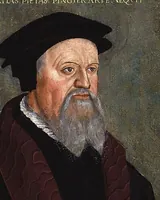
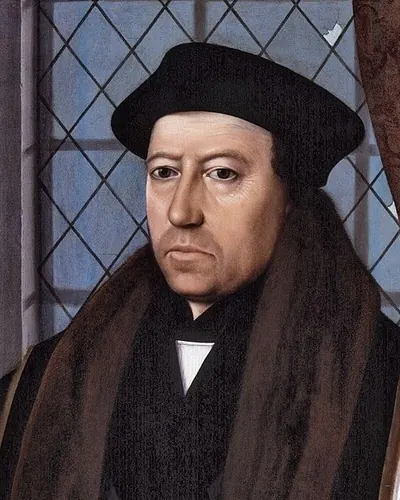
Portrait of Thomas Cranmer
Portrait: Gerlach Flicke · Public domain · Wikimedia Commons. Cropped and resized by Credo.

Anglican · Reformation

Thomas Cranmer

1489 – 1556

Common prayer in the people’s tongue

Archbishop of Canterbury under Henry VIII and Edward VI, Cranmer shaped the English Reformation through the Book of Common Prayer, whose cadences still mark English worship. He taught justification by faith and a spiritual presence of Christ in the Supper, and was burned at Oxford under Mary I.

How close are you? All theologians

Where Cranmer stands

God & Revelation

  • Can human reason reach God, or only God's self-revelation?Faith seeking understanding
  • Is God beyond change and suffering, or moved by the world?Classical theism 85%
  • Does Scripture stand alone, or within the Church's Tradition?Scripture alone 80%

Grace & Salvation

  • Does salvation rest finally on God's choice or on a free human response?Sovereign election 75%
  • Will all be saved in the end, or only some?Particularism 80%
  • Is salvation chiefly a verdict or a transformation?Forensic justification 85%

Church & World

  • Do sacraments convey what they signify, or commemorate it?Memorial & symbol 65%
  • Is authority in the Church handed down or held in common?Hierarchical 75%
  • Should the Church stand apart from society or work to transform it?Transforming society 70%

Method & Spirit

  • Is theology a rigorous science or a contemplative ascent?Systematic reason 60%
  • Read the Bible first as history, or first as the Church's book?Theological & canonical 70%
  • Does doctrine develop and revise, or guard a fixed deposit?Fixed tradition 75%

Why these placements

Book of Common Prayer (1549, 1552) and the Homily of Salvation (justification by faith); Defence of the True and Catholic Doctrine of the Sacrament (spiritual presence); retained bishops within a royal supremacy; Forty-two Articles.

Key works

  • Book of Common Prayer, 1549 and 1552
  • Homilies (incl. Of Salvation), 1547
  • Defence of the True and Catholic Doctrine of the Sacrament, 1550

Sources

Read more about Cranmer

10 verified links: reference articles, Cranmer's own writings where a free text exists, and peer-reviewed scholarship (open access first). Links open in a new tab.

Scholarship

Kindred spirits

Furthest apart

How close are you?