Theologians / Erasmus

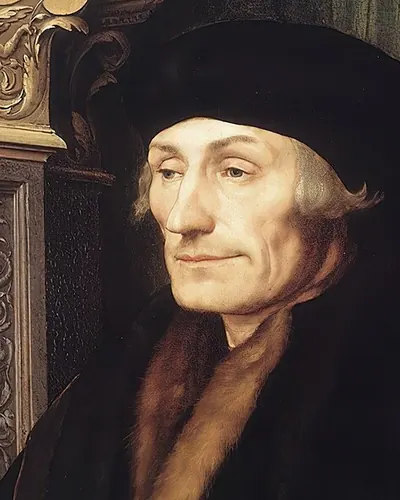
Portrait of Desiderius Erasmus
Portrait: Hans Holbein the Younger · Public domain · Wikimedia Commons. Cropped and resized by Credo.

Catholic (humanist) · Reformation

Desiderius Erasmus

1466 – 1536

Back to the sources: the philosophy of Christ

The great humanist scholar of the Renaissance, Erasmus published the first printed Greek New Testament and mocked clerical abuses in the Praise of Folly. He urged a simple, inward ‘philosophy of Christ’, defended free will against Luther, and stayed within the Catholic Church while pleading for peace.

How close are you? All theologians

Where Erasmus stands

God & Revelation

  • Can human reason reach God, or only God's self-revelation?Natural theology 65%
  • Is God beyond change and suffering, or moved by the world?Classical theism 65%
  • Does Scripture stand alone, or within the Church's Tradition?Prima Scriptura

Grace & Salvation

  • Does salvation rest finally on God's choice or on a free human response?Synergy 90%
  • Will all be saved in the end, or only some?Wider hope
  • Is salvation chiefly a verdict or a transformation?Transformation & theosis 70%

Church & World

  • Do sacraments convey what they signify, or commemorate it?Memorial & symbol 60%
  • Is authority in the Church handed down or held in common?Hierarchical 60%
  • Should the Church stand apart from society or work to transform it?Transforming society 75%

Method & Spirit

  • Is theology a rigorous science or a contemplative ascent?Mystical & apophatic 60%
  • Read the Bible first as history, or first as the Church's book?Historical-critical 75%
  • Does doctrine develop and revise, or guard a fixed deposit?Development & revision 60%

Why these placements

On Free Will (1524) against Luther; Enchiridion (inward piety over outward ceremony); philological work on the Greek New Testament (historical method); irenic, reforming stance within Catholicism; generous hope for virtuous pagans.

Key works

  • Handbook of the Christian Soldier (Enchiridion), 1503
  • Praise of Folly, 1511
  • Greek New Testament (Novum Instrumentum), 1516
  • On Free Will, 1524

Sources

Read more about Erasmus

15 verified links: reference articles, Erasmus's own writings where a free text exists, and peer-reviewed scholarship (open access first). Links open in a new tab.

Primary texts

Show 2 more

Kindred spirits

Furthest apart

How close are you?