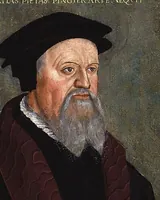
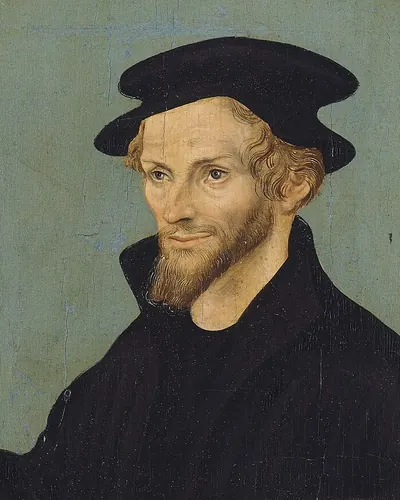
Portrait: Workshop of Lucas Cranach the Elder · Public domain · Wikimedia Commons. Cropped and resized by Credo.
Lutheran · Reformation
Philip Melanchthon
1497 – 1560
The teacher of Germany
A humanist scholar of Greek who joined Luther at Wittenberg, Melanchthon wrote the first Protestant systematic theology and drafted the Augsburg Confession. He reorganised German schools and universities. More open than Luther to reason and to agreement with others, he later gave the human will some role in conversion, which caused disputes after his death.
Can human reason reach God, or only God's self-revelation?Natural theology 60%
Natural theologyRevelation alone
Is God beyond change and suffering, or moved by the world?Classical theism 80%
Classical theismRelational God
Does Scripture stand alone, or within the Church's Tradition?Scripture alone 80%
Scripture aloneScripture & Tradition
Grace & Salvation
Does salvation rest finally on God's choice or on a free human response?Enabling grace
Sovereign electionSynergy
Will all be saved in the end, or only some?Particularism 75%
Universal hopeParticularism
Is salvation chiefly a verdict or a transformation?Forensic justification 95%
Forensic justificationTransformation & theosis
Church & World
Do sacraments convey what they signify, or commemorate it?Sacramental realism 70%
Sacramental realismMemorial & symbol
Is authority in the Church handed down or held in common?Hierarchical 65%
HierarchicalCongregational
Should the Church stand apart from society or work to transform it?Transforming society 70%
Distinct communityTransforming society
Method & Spirit
Is theology a rigorous science or a contemplative ascent?Systematic reason 95%
Systematic reasonMystical & apophatic
Read the Bible first as history, or first as the Church's book?Theological & canonical 60%
Historical-criticalTheological & canonical
Does doctrine develop and revise, or guard a fixed deposit?Fixed tradition 70%
Development & revisionFixed tradition
Why these placements
Loci Communes (first Protestant systematic theology); Augsburg Confession and Apology (forensic justification); later ‘synergist’ wording on the will; humanist educational reform; Variata on the Supper (softened realism).
Melanchthon's own writings, listed under key works
Read more about Melanchthon
6 verified links: reference articles, Melanchthon's own writings where a free text exists, and peer-reviewed scholarship (open access first). Links open in a new tab.

 God & Revelation
 Grace & Salvation
 Church & World
 Method & Spirit